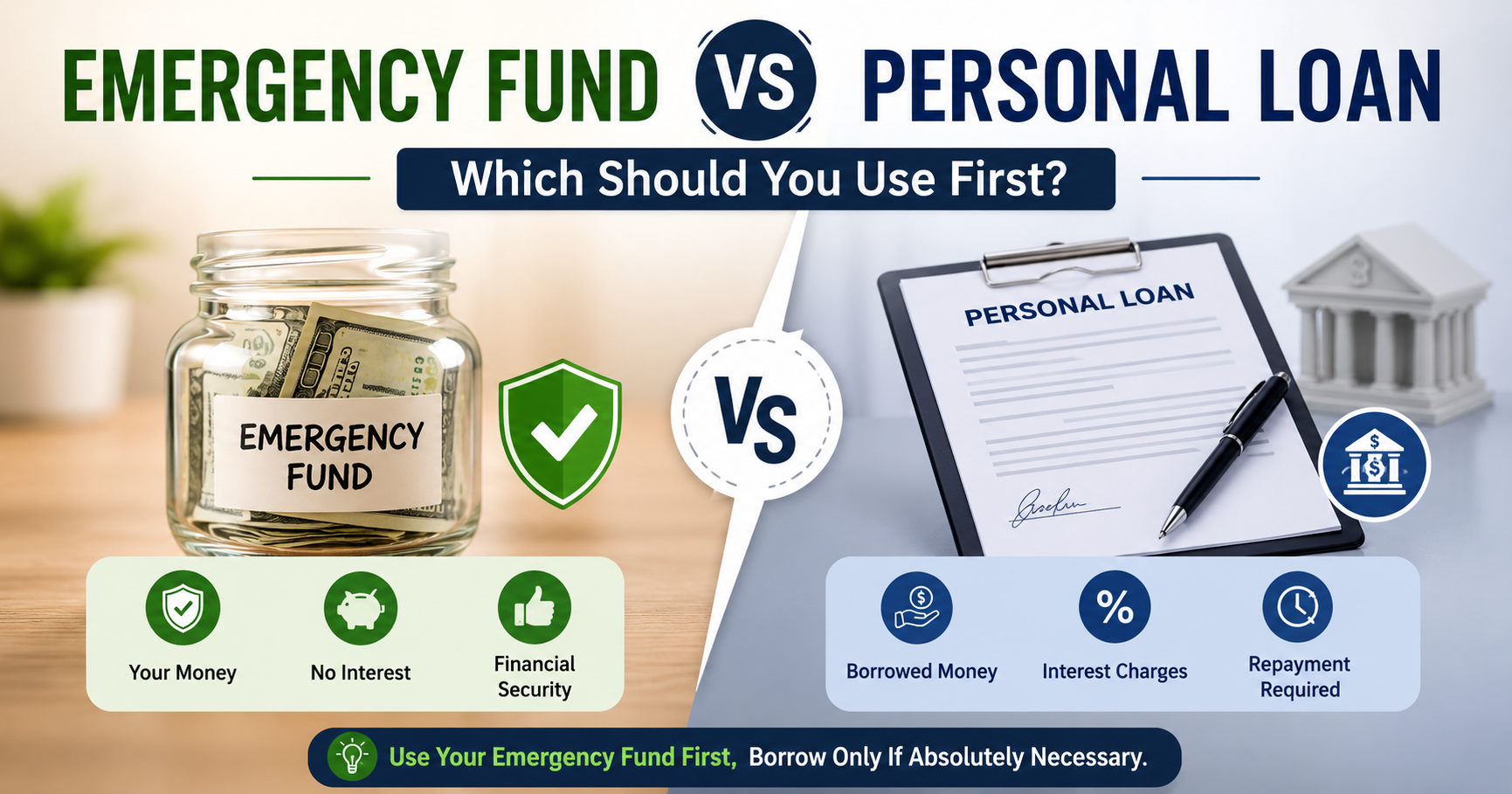
When a financial emergency hits a car breakdown, a medical bill, a sudden job gap most Americans face the same question: do I pull from my savings, or do I take out a loan? Both options can cover the gap, but the right choice depends on your situation, and picking the wrong one can cost you more than the emergency itself.
This guide walks you through exactly when to use your emergency fund, when a personal loan makes more sense, and how to decide quickly without second-guessing yourself later.
What Is an Emergency Fund?
An emergency fund is money you have already saved, kept in a liquid account like a savings account or money market account, specifically for unexpected expenses. Financial advisors in the US generally recommend keeping three to six months of essential living expenses in your emergency fund enough to cover rent, utilities, groceries, and minimum debt payments if your income suddenly stopped.
The key advantage of an emergency fund is simple: it is your money. There is no application, no credit check, no interest, and no monthly repayment. You use it, then rebuild it over time.
What Is a Personal Loan for Emergencies?
A personal loan is a fixed amount of borrowed money typically between $100 and $5,000 for short-term needs that you repay in scheduled monthly installments over an agreed term. Personal loans carry an APR (annual percentage rate) that ranges from as low as 5.99% to as high as 35.99% depending on your credit profile, income, and the lender.
Personal loan APRs can reach well over 20% for borrowers with average or below-average credit, which means the actual cost of borrowing is real and worth factoring into your decision.
In the US, personal loans for emergencies can be approved and funded within 24 to 48 hours through a loan matching service making them a genuinely fast option when your savings are not enough.
Emergency Fund First: When Using Your Savings Is the Right Call
In most situations, your emergency fund should be the first resource you reach for. Here is when using it makes clear financial sense.
The expense is within your fund balance. If your emergency fund covers the full cost of the expense and still leaves you with at least one month of living expenses, use it. Paying zero interest is always cheaper than paying any interest.
The expense is a true one-time emergency. Car repair, dental bill, broken appliance, minor medical co-pay these are exactly what the fund exists for. Using it is not a failure; it is the plan working correctly.
You have a stable income to rebuild it. If you are employed and can realistically rebuild your fund within 3 to 6 months through regular contributions, depleting it for an emergency is perfectly sound. The fund is meant to be used and replenished.
You want zero impact on your credit score. Using your emergency fund has no impact on your credit score unlike a personal loan, which involves a credit inquiry and adds to your debt obligations.
Personal Loan First: When Borrowing Makes More Sense
There are situations where reaching for a personal loan rather than your savings is actually the smarter financial move.
Your emergency fund is already empty or insufficient. Many Americans struggle to manage unplanned expenses, with a significant portion unable to handle even a $400 unexpected expense. If your savings do not cover the full cost, a personal loan fills the gap without forcing you to overdraft, use high-interest credit cards, or borrow from family.
The expense would wipe out your entire safety net. If using your emergency fund would leave you with zero buffer and you have stable income to handle loan payments borrowing may be the better choice. Your emergency fund exists to protect you from back-to-back emergencies; draining it completely for one expense removes that protection entirely.
The expense is large and interest rates are manageable. For expenses above $2,000 to $3,000, compare the cost of loan interest against the risk of having no savings at all. If you qualify for a rate below 15% and can comfortably make monthly payments, a personal loan preserves your savings buffer while still solving the immediate problem.
You need to protect a high-yield savings account. If your emergency fund is in a high-yield savings account earning 4% to 5% APY, and you qualify for a personal loan at a comparable or lower rate, keeping your savings invested while borrowing may actually make mathematical sense.
Side-by-Side: Emergency Fund vs Personal Loan
| Factor | Emergency Fund | Personal Loan |
|---|---|---|
| Cost | Free (no interest) | APR 5.99%–35.99% |
| Speed | Immediate | 24–48 hrs (typical) |
| Credit score impact | None | Soft pull to browse; hard pull at approval |
| Monthly repayment | None | Fixed monthly installments |
| Best for | Expenses within your savings balance | Expenses that exceed your fund |
| Rebuilding required | Yes — replenish over time | No — loan is repaid to lender |
| Availability | Only if you have savings | Available to most US borrowers |
The Hybrid Approach: Use Both
Using a portion of your emergency fund to cover immediate needs while obtaining a personal loan to manage the remaining balance can preserve some savings and minimize total debt.
For example: if you face a $3,000 car repair and your emergency fund has $2,000, consider using your savings for the first $2,000 and applying for a small personal loan to cover the remaining $1,000. This keeps some financial cushion in place and reduces the amount you need to borrow which means lower interest costs overall.
This hybrid approach works especially well when:
- The total expense significantly exceeds your fund
- You have good enough credit to qualify for a low APR
- You can replenish your emergency fund and repay the loan simultaneously
What Most Americans Get Wrong
The most common mistake is treating the two options as opposites either drain your savings completely or borrow everything. In reality, the smartest financial decisions almost always involve some combination of both, calibrated to the size of the emergency and the state of your savings.
A second common mistake is using a high-interest credit card as a default when both options above are available. Personal loan APRs average significantly lower than credit card rates, making a personal loan a far better borrowing tool if you do need to borrow.
What to Do Right Now If You Have No Emergency Fund
If you are reading this mid-emergency and have no savings to draw from, a personal loan is likely your best immediate option especially if it prevents you from missing rent, defaulting on existing debt, or delaying urgent medical care.
You can apply for a personal loan at Nexus Loan Hub all credit scores are welcome, there are no upfront fees, and checking your options will not affect your credit score. Lenders in our network offer between $100 and $5,000 with funds typically available within 24 to 48 hours of approval.
Once the emergency is resolved, building even a small emergency fund starting with $500 to $1,000 dramatically reduces how often you will need to borrow in the future.
How to Rebuild Your Emergency Fund After Using It
Once the emergency passes, your next priority should be rebuilding your fund before the next unexpected expense arrives. A simple approach:
Set a fixed monthly contribution even $50 to $100 per paycheck adds up to $1,200 per year. Keep the fund in a separate high-yield savings account so it stays out of sight and earns interest while sitting idle.
If you also have a personal loan to repay, prioritize the loan repayment first (to avoid interest stacking), then redirect those payments to your savings fund once the loan is paid off. This creates a natural financial reset cycle after each emergency.
For a detailed look at how loan repayment terms and APR ranges work, visit at Nexus Loan Hub to understand exactly what to expect before you borrow.
Final Answer: Which Should You Use First?
Use your emergency fund first if the expense is within your balance and you can rebuild it within a few months.
Use a personal loan if your savings are insufficient, fully depleted, or if wiping them out would leave you dangerously exposed to a second emergency.
Use both if the expense is large enough to require it cover what you can from savings, borrow only the difference.
The goal in every case is to solve the emergency at the lowest total cost, while keeping enough of a financial buffer to protect yourself going forward.
-
Should I use my emergency fund or take a personal loan for unexpected expenses in the US?
Use your emergency fund first if it covers the full expense and still leaves you with at least one month of living expenses as a buffer. If your savings are insufficient or would be completely wiped out, a personal loan is a better option especially if you qualify for a rate below 20% APR. For large expenses, consider a hybrid approach: use your savings for part of the cost and borrow only the remaining balance.
-
Is it bad to drain your emergency fund completely?
Depleting your emergency fund entirely leaves you financially exposed to any new unexpected expense that follows. Financial advisors in the US generally recommend keeping at least one month of essential expenses in reserve even after using your fund. If a single emergency would zero out your savings, a personal loan may be the smarter choice — it preserves your safety net while still covering the immediate cost.
-
How quickly can I get a personal loan for an emergency in the US?
Most online lenders and loan matching services in the US can approve and fund a personal loan within 24 to 48 hours of receiving your application. Some lenders offer same-day funding for applications submitted and verified before noon on a business day. This makes personal loans a genuinely fast alternative when your savings are insufficient to cover an urgent expense.
-
Does applying for a personal loan for an emergency hurt my credit score?
Browsing loan options through a matching service uses a soft credit inquiry, which does not affect your credit score at all. A hard credit inquiry which can temporarily lower your score by a few points only occurs when you formally accept an offer and proceed with a specific lender. Responsible repayment of a personal loan can actually improve your credit score over time by adding a positive payment history to your credit report.
-
What is the best personal loan amount for a financial emergency in the US?
The best loan amount is the smallest amount that fully resolves the emergency without overborrowing. For most short-term emergencies in the US car repairs, medical bills, utility gaps amounts between $500 and $3,000 are sufficient. Borrowing more than you need increases your total interest cost and extends your repayment period. Use your emergency fund to cover as much as possible and borrow only the remaining gap.
Responsible Borrowing Disclaimer
Disclaimer: Nexus Loan Hub is a free loan matching service that connects borrowers with participating lenders. We are not a lender and do not make credit decisions. Rates, terms, and availability vary by lender and creditworthiness. Not all applicants will qualify for a loan or the advertised rates and terms. Loans are subject to credit approval and verification. Funding times may vary depending on verification requirements and lender policies. Available in most states – some restrictions may apply based on state regulations.