Introduction: Pros and Cons of Installment Loans
American households carried $18.8 trillion in total debt as of Q4 2025, according to the Federal Reserve Bank of New York. Personal loan balances alone grew 104% between 2018 and 2025. Yet most borrowers still don’t fully understand the pros and cons of installment loans before they sign.
This guide gives you a transparent, data-backed breakdown covering benefits, risks, real costs, and a clear decision framework so you can borrow with confidence.
Table of Contents
What Is an Installment Loan?
An installment loan is a fixed lump-sum loan repaid in equal, scheduled monthly payments over a set term, at a fixed or variable interest rate.
Common types include:
- Personal loans
- Auto loans
- Mortgages
- Student loans
- Debt consolidation loans
Unlike revolving credit (credit cards, HELOCs), installment loans have a defined start and end date. Once repaid, the account closes. There is no reusable credit line.
Pros and Cons of Installment Loans at a Glance
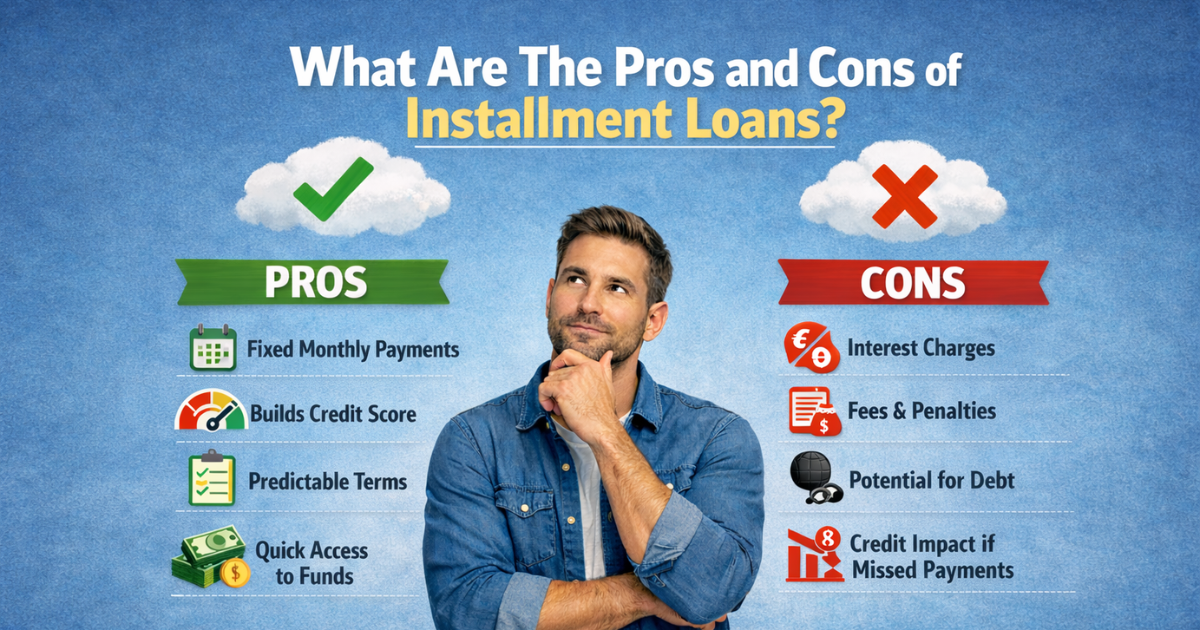
| Pros | Cons |
| Fixed, predictable monthly payments | Origination fees of 1%–8% |
| Fixed interest rate no rate spike risk | No re-borrowing after disbursement |
| Builds credit history (35% of FICO) | Hard inquiry lowers score 5–10 pts |
| Lower APR than credit cards (11.6% vs 22.3%) | Prepayment penalties on some loans |
| Clear payoff date no revolving debt trap | Collateral risk on secured loans |
| Effective for debt consolidation | Longer terms = significantly more interest |
Advantages of Installment Loans
1. Predictable Fixed Payments
Every payment is the same amount on the same date each month. This makes budgeting straightforward and eliminates the uncertainty of variable credit card minimums. You know your exact payoff date from day one.
2. Fixed Interest Rate Protection
Most personal installment loans carry fixed rates. When credit card APRs hit a record 22.3% average in Q4 2025, fixed-rate installment borrowers were fully protected. The average 24-month personal loan rate was 11.6%, nearly half the average card rate.
3. Credit Score Benefits
Payment history accounts for 35% of your FICO score, the single largest factor. Consistent on-time installment payments build your score over the loan term. Crucially, installment balances do not count toward your credit utilization ratio, so they won’t penalize your score the way high card balances do.
4. Lower APR Than Credit Cards
The average personal loan APR in 2025 was 11.6%. The average credit card rate was 22.3%. For balances over $5,000 held 12+ months, this difference produces significant savings.
5. Debt Consolidation Savings
A borrower with $12,000 across three credit cards at 21% APR can consolidate into a 36-month personal loan at 12% APR and save approximately $2,100 in interest while reducing three payments to one.
6. Defined Payoff Date
An installment loan has a contractual end date. This creates financial accountability that open-ended revolving credit never provides.
Disadvantages of Installment Loans
1. Origination Fees Reduce Net Proceeds
Many lenders charge 1%–8% origination fees, deducted before funding. A $10,000 loan with a 5% fee delivers only $9,500, but you repay the full $10,000 plus interest. Always compare APR, not just the interest rate. APR includes all fees and is legally required under the Truth in Lending Act (TILA).
2. No Flexibility to Re-Borrow
Once disbursed, the loan is closed. If your costs exceed the loan amount, you must reapply, triggering a new credit inquiry, new underwriting, and potentially worse terms. This inflexibility is the chief disadvantage vs. a HELOC or credit card.
3. Longer Terms Cost Far More
| Term | Monthly Payment | Total Interest |
| 12 months | $888 | $661 |
| 24 months | $470 | $1,280 |
| 36 months | $332 | $1,957 |
| 48 months | $263 | $2,651 |
| 60 months | $222 | $3,347 |
Based on $10,000 at 12% APR. Never choose a term based solely on payment size.
4. Hard Credit Inquiry
Every application triggers a hard pull, reducing your FICO score by 5–10 points for up to 12 months. Rate-shop within a 14–45 day window. FICO treats multiple inquiries in this period as a single inquiry.
5. Collateral Risk on Secured Loans
Auto loan delinquency reached 1.45% in Q3 2025. On secured installment loans, default means repossession or foreclosure. Understand exactly what asset you are pledging before signing.
Installment Loans vs. Revolving Credit
| Feature | Installment Loan | Revolving Credit |
| Payment structure | Fixed monthly | Variable, balance-based |
| Interest rate | Usually fixed | Usually variable |
| Fund access | One-time lump sum | Ongoing, up to limit |
| Credit utilization | Not affected | Directly impacted |
| Payoff timeline | Defined end date | Open-ended |
| Avg 2025 APR | 11.6% (personal) | 22.3% (credit cards) |
Use installment loans for one-time, defined expenses. Use revolving credit for ongoing, variable spending you’ll pay in full monthly.
Are Installment Loans Good or Bad? Key Qualifying Factors
Whether an installment loan is good or bad depends on four factors that you and lenders should evaluate:
- Credit Score — Best rates require 740+. Most prime lenders approve 670+. Subprime options exist from 580 but carry APRs up to 36%.
- Debt-to-Income Ratio (DTI) — Divide total monthly debt payments by gross monthly income. Under 36% is ideal. Above 43%, most prime lenders will decline.
- Income Stability — 6+ months at current employer preferred; 2+ years for larger loans.
- Loan Purpose — Debt consolidation, home improvement, and major purchases are viewed as lower risk than general cash requests.
When to Apply for an Installment Loan
Apply when:
- Consolidating high-rate debt at a meaningfully lower APR
- Financing a specific, one-time expense with a defined cost
- Your DTI stays under 36% after adding the new payment
- You have a stable income for the full loan term
Avoid when:
- Borrowing to cover recurring living expenses (rent, groceries)
- Your DTI already exceeds 43%
- You’re planning a mortgage application within 6 months
Why Choose NexusLoanHub for Installment Loans
Before applying for an installment loan, take time to explore your options with NexusLoanHub. Our platform helps you compare lenders, understand interest rates, review repayment terms, and choose a loan that fits your financial situation. NexusLoanHub is committed to providing transparent information so you can borrow confidently and responsibly.
Frequently Asked Questions (FAQs)
Are installment loans good or bad?
Installment loans can be good when used responsibly. They offer fixed monthly payments, structured repayment, and potential credit-building benefits. However, they can become costly if the APR is high or the loan term is extended. Whether they are good or bad depends on your credit profile, income stability, and repayment discipline.
What credit score is needed for an installment loan?
Most lenders prefer a credit score of 670 or higher for competitive rates. Borrowers with scores between 580–669 may qualify but often pay higher APRs. Some lenders approve lower scores, but rates can reach 30% or more. Higher credit scores typically mean better terms and lower monthly payments.
Can I pay off an installment loan early?
Yes, most U.S. installment loans allow early repayment. Paying off early can reduce total interest costs. However, some lenders charge prepayment penalties, though they are less common in 2026. Always review your loan agreement to confirm whether early payoff fees apply.
Do installment loans hurt your credit?
Applying may cause a temporary 3–5 point drop due to a hard inquiry. However, making consistent on-time payments can improve your credit score over time. Missed payments, defaults, or late payments can significantly damage your credit and remain on your report for up to seven years.
What is the average APR for installment loans?
The average APR for personal installment loans in the U.S. ranges from 5.99% to 35.99%, depending on credit score, income, and lender policies. Borrowers with excellent credit receive the lowest rates, while subprime borrowers typically pay higher interest.
Are installment loans better than payday loans?
Yes. Installment loans generally have much lower APRs and longer repayment terms compared to payday loans, which often exceed 300% APR. Installment loans provide structured payments and reduced risk of debt spirals, making them a safer borrowing option for most consumers.
How long do installment loans stay on your credit report?
An installment loan remains on your credit report for up to 10 years after it is paid off if closed in good standing. Late payments or defaults can remain for seven years from the date of delinquency.
Can you refinance an installment loan?
Yes, many lenders allow refinancing. Refinancing can lower your interest rate, reduce monthly payments, or adjust the loan term. Approval depends on your updated credit score, income, and debt-to-income ratio. Always compare total interest costs before refinancing.
Responsible Borrowing Disclaimer
Disclaimer: Nexus Loan Hub is a free loan matching service that connects borrowers with participating lenders. We are not a lender and do not make credit decisions. Rates, terms, and availability vary by lender and creditworthiness. Not all applicants will qualify for a loan or the advertised rates and terms. Loans are subject to credit approval and verification. Funding times may vary depending on verification requirements and lender policies. Available in most states – some restrictions may apply based on state regulations.